Written by:
Pierce J.
Published:
October 7, 2026
Learn how to store a pre-lit Christmas tree so branches keep their shape and the lights still work next season. A practical guide for movers and holiday prep.
A pre-lit Christmas tree almost never fails because the bulbs burn out. It fails because the wiring gets kinked, crushed, or yanked loose during the eleven months it spends folded into a box in the attic or garage. Learning how to store a pre-lit Christmas tree correctly comes down to protecting the wire connections at each hinge point, keeping the storage container upright instead of stacked flat, and controlling temperature and moisture so the PVC needles do not turn brittle. Get those three right and a decent pre-lit tree can last a decade or more.
This matters more than people expect, especially if you are storing the tree through a move. A tree that got tossed in a moving box loose last December is usually the one with three dark sections this December. Here is how to pack it so that does not happen, whether it is sitting in a closet for a year or riding in a moving truck across town.
Most pre-lit trees fail at the wire connections between sections, not at the bulbs themselves. Folding branches down for storage puts repeated stress on the same few inches of wire every year until the copper fatigues and breaks inside the insulation, which is invisible until you plug the tree in and a whole section goes dark.
The other common culprit is moisture. Artificial trees stored in a garage, basement, or shed are exposed to humidity swings that can corrode connectors and encourage mildew on the tree bag itself. Heat is a slower killer: attics that swing above 90 degrees in summer soften the PVC needles and the glue holding branches into the hinges, so they droop and shed over time. None of this is sudden. It is accumulated damage from a storage spot and method that were never really built for a decade of seasonal use.
Disassembled is almost always the better call, even though an upright tree bag feels like less work. Fully assembled storage puts constant tension on the branch hinges and wiring for 11 months a year, while a properly sectioned tree spreads that stress out and takes up a fraction of the space.
Break the tree down into its original sections (most pre-lit trees come in two to four pieces that stack or hinge). Before folding any branches flat, unplug each section from the next at its designated connector rather than pulling on the wire itself. If your tree is a hinged "pop-up" style where branches fold against the trunk, fold them gently in the same direction they were designed to collapse. Forcing a branch backward against its hinge is the single fastest way to snap a wire that was fine the week before.
Some people store smaller tabletop pre-lit trees fully assembled inside a tree storage bag with a rigid base, and that is fine as long as the bag has enough clearance that branches are not crushed against the sides. For anything over four feet, disassembly is worth the extra ten minutes.
An upright, rolling tree storage bag with a rigid duffel-style frame protects a pre-lit tree far better than a flat cardboard box, because it keeps branches in their natural hanging position instead of stacking weight on top of the wiring. If you do use a box, choose one sized to the tree sections rather than cramming everything into whatever is on hand.
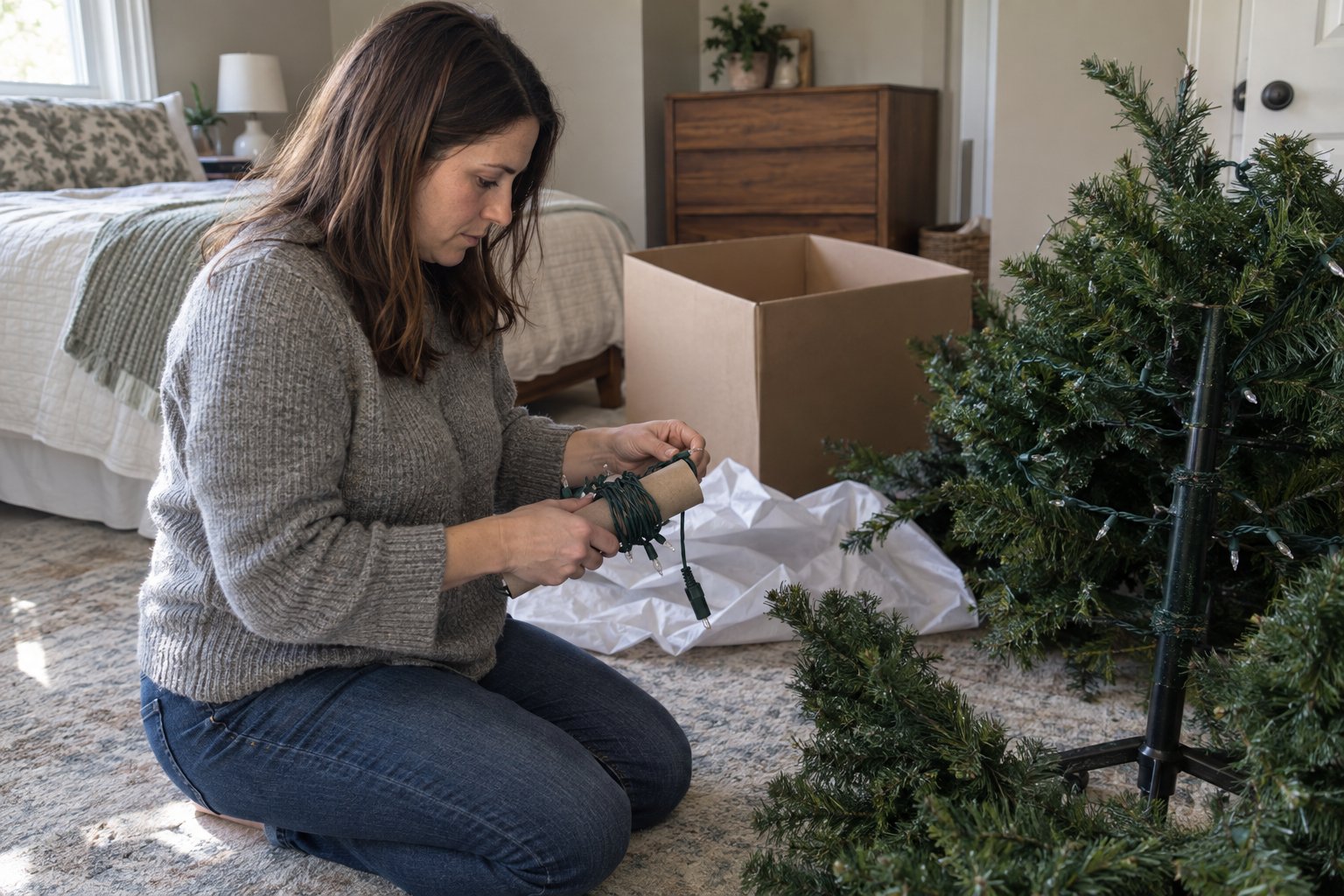
Whatever you use, wrap each section's light strand loosely around the branch structure rather than letting it dangle loose where it can snag on the container zipper or another section during handling.
Protecting the wiring means minimizing sharp bends, keeping connectors mated or capped, and never storing the tree with tension on any single wire segment. A few extra minutes here is what separates a tree that lights up fully next November from one with a dead zone in the middle.
Before folding branches, loosely coil any slack wire and secure it to the branch with a twist tie or velcro strap rather than letting it hang. Check that every male-to-female connector between sections is either still plugged together or capped with the small plastic covers that came with the tree, since exposed prongs corrode faster and are an easy place for moisture to get in. If a bulb or small section is already flickering, address it before storage rather than after, since a known bad connection often gets worse from another year of handling.
A climate-controlled closet, spare room, or interior storage space beats a garage or attic for a pre-lit tree every time, because stable temperature and low humidity protect both the PVC needles and the wiring insulation. If interior space is not realistic, a few precautions make an exterior spot workable.
Keep the storage bag off a concrete garage floor on a shelf or pallet, since concrete holds moisture that can wick into the bag over time. In an attic, avoid placing the tree directly under the roofline where summer heat is most intense. A sealed plastic tub liner inside a fabric storage bag adds a moisture barrier in either location. If you are between homes and the tree is sitting in a storage unit as part of a larger move, the same rules apply: upright if possible, off the floor, and away from a unit's exterior wall where temperature swings are worst.
A pre-lit tree being transported during a move needs the same upright, unstacked handling it needs in long-term storage, just over a shorter timeline. The biggest risk during a move is not storage conditions, it is other boxes getting stacked on top of the tree bag in a packed truck.
Load the tree bag last or on top of a stable, flat surface in the truck, never underneath furniture or heavier boxes. If you are working with a crew, flag the bag so it does not get treated like a generic box. For families moving during the holiday season or packing up decorations as part of a larger relocation, our team can handle fragile and awkward seasonal items alongside the rest of the load; see our packing services for how we protect items like this in transit. If the tree is just one piece of a much bigger job, our guide on how to pack a moving truck covers how we sequence fragile, lightweight items like tree bags against heavier furniture so nothing gets crushed.
With proper storage, a quality pre-lit tree typically holds up for eight to twelve years before enough connections fail that replacing strands is more work than it's worth. Cheaper trees with thinner wiring tend to show problems sooner, sometimes within three or four seasons, regardless of how carefully they're stored.
If you are decluttering other seasonal or bulky items as part of a move and the tree did not survive, that is a good moment to clear out anything else that did not make the cut. Our guide on how to downsize before a move walks through deciding what is worth keeping, including holiday items that take up disproportionate storage space for one month of use a year.
If you are planning a move this holiday season and want decorations, trees, and other seasonal items packed and handled by people who do this daily, get a moving quote from our team and we will build the job around what actually needs careful handling.
You can for short periods, but upright storage is better for the wiring. Laying a folded tree flat for months puts uneven pressure on whichever branches end up on the bottom, and that pressure is often what kinks a wire enough to break a connection by the time you unpack it next season.
This almost always points to a broken connection at one of the plug-in points between tree sections, not a universal bulb failure. Check that each section is fully plugged into the next, inspect for visibly bent or corroded prongs, and test each section individually before assuming you need a full replacement.
Plastic wrap can trap humidity against the branches and wiring, which does more harm than good over a long storage period. A breathable fabric storage bag protects against dust and light damage without sealing in moisture the way plastic wrap can.
A dedicated upright storage bag is worth it if the tree is over four feet or you plan to keep it more than a couple of seasons. The upright design keeps weight off the wiring in a way a stacked box cannot, and most bags last longer than the original cardboard packaging.
Extreme cold is generally less damaging than extreme heat for PVC and wiring, but repeated freeze-thaw cycles combined with humidity can still stiffen insulation over years of storage. A moderate, dry space is preferable to either a very hot attic or a consistently damp unheated garage.
Whether it’s a full home move or just a few heavy items, Hustle and Muscle Moving is ready to help you sort it out.