Written by:
Pierce J.
Published:
October 16, 2026
Learn how to move a recliner or reclining sofa without snapping the frame or jamming the reclining mechanism, from locking it down to loading it right.
A recliner is deceptively hard to move because the part that makes it comfortable is also the part that breaks first. Learning how to move a recliner safely means protecting the internal reclining mechanism, not just the upholstery, since a bent linkage arm or a snapped cable can leave the chair stuck half-open for good. The frame can survive a rough move. The mechanism rarely does.
Recliners get damaged in transit because the mechanism underneath relies on a chain of metal linkage bars, springs, and sometimes motors that are only designed to move in one controlled direction. Tilt the chair on its side, drag it across a floor, or let it shift in the truck, and that linkage can bend, pop out of its mounting bracket, or jam mid-recline.
Unlike a standard armchair, a recliner is not a single rigid shape. It is a moving assembly held together under tension, and most of that tension is hidden beneath the base panel where you cannot see it flex. If the chair isn't locked in a fixed position before it's lifted, even careful movers can unintentionally stress a part that was never meant to bear weight while partially extended.
Locking the mechanism means leaving the chair fully closed and securing it so it cannot pop open mid-move. Most manual recliners stay closed on their own once the footrest is down, but a worn mechanism can creep open under vibration, so a wrap of moving tape or a long strap cinched around the closed footrest adds insurance.
Check the chair in its fully upright, fully closed position, not reclined and not with the footrest partially up. Run a ratchet strap or soft furniture strap around the body of the chair, over the closed footrest panel, and buckle it snug. Avoid tape directly on leather or delicate fabric since it can pull finish off on removal; use a moving blanket as a barrier first if the strap needs to cross upholstery.
If the chair has a motorized mechanism, unplug it and check the battery backup unit (if it has one) before moving day. Wrap the power cord and remote control unit together and tape them to the underside of the chair so nothing snags on a doorway or gets left behind. Never move a power recliner while it's still plugged in or mid-cycle.
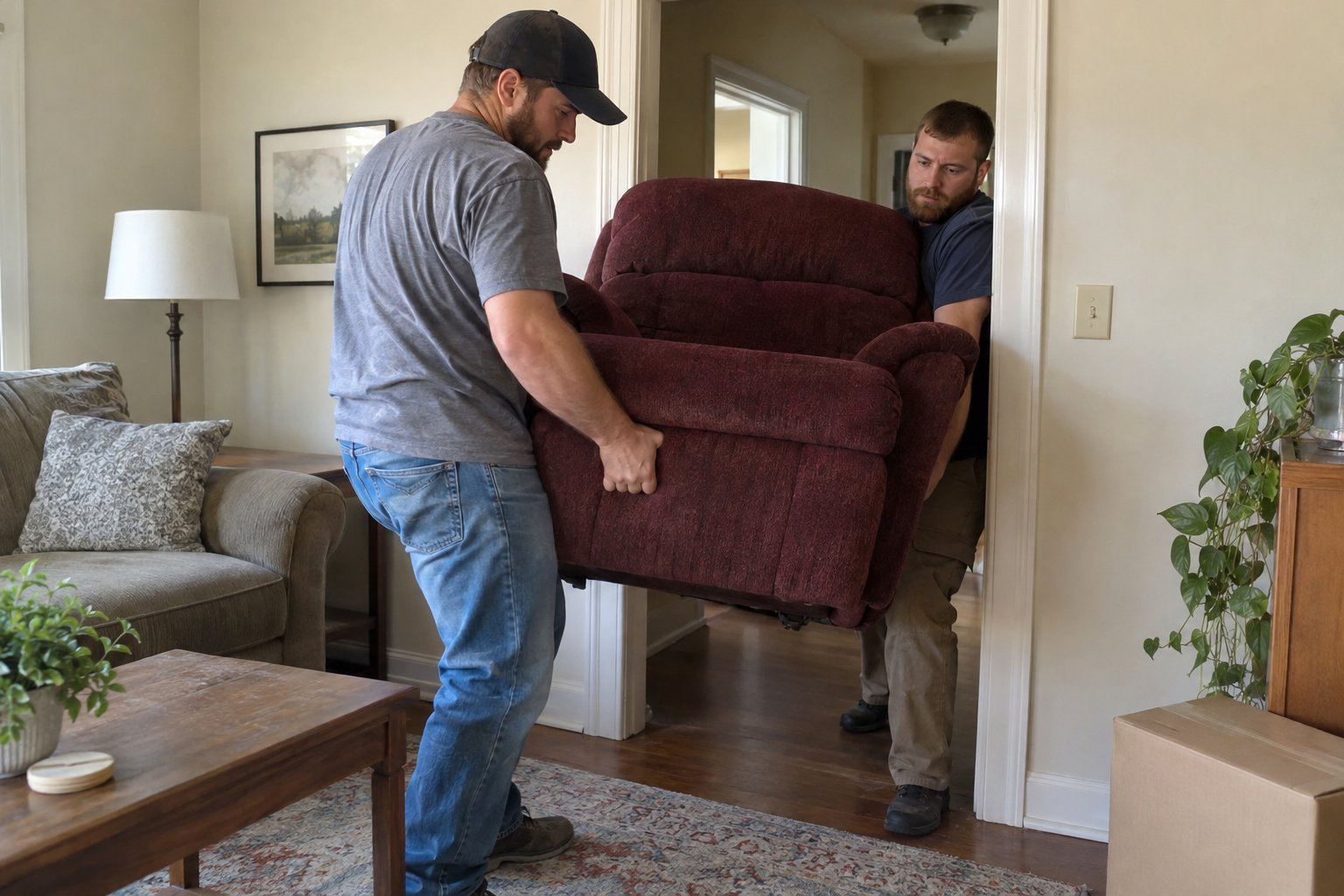
A recliner should be carried upright whenever possible, tilted back slightly onto its rear legs rather than laid on its side, since laying it flat puts uneven pressure on the mechanism's mounting brackets. Two people, one at each side gripping the solid frame rather than the upholstered arms, gives the most control through tight spaces.
For doorways narrower than the chair's widest point, tilt the top back and walk it through at an angle, feeding the base through first. Remove the back cushion if it detaches, since that alone can shave several inches off the width you need to clear. If a hallway turn is too tight no matter the angle, check whether the chair has a removable back panel; some reclining sofas and oversized recliners are designed to split for exactly this reason.
Stairs are where most mechanism damage happens, because the chair's weight shifts suddenly if a carrier loses their grip. Go slow, keep the chair as upright as the stairwell allows, and have a third person spot from below on anything steeper than a shallow staircase.
A recliner should load upright, braced against a wall of the truck or another stable piece of furniture, with straps running through its frame rather than its upholstery. Laying it on its back for the ride is the single most common cause of a bent footrest linkage, because the full weight of the chair presses down on the mechanism housing for the entire trip.
Give it a padded, upright spot near the front of the load where it won't shift, and don't stack boxes directly on top of the seat or footrest panel. If you're loading a full reclining sofa, keep in mind it's heavier and more awkward than a single recliner and usually needs more than two people to maneuver without wrenching a side-by-side mechanism.
A single manual recliner is usually manageable for two reasonably strong people, but a reclining sectional, a dual-power loveseat, or a recliner that has to clear a tight stairwell is a different problem entirely. The weight is awkward to distribute evenly, and a dropped corner can bend the mechanism in a way that's expensive or impossible to fix.
If your move involves several large upholstered pieces or a layout with narrow hallways, bringing in labor-only moving assistance for the heavy lifting lets you keep control of packing and logistics while leaving the carrying to people who do it daily. It's also worth checking our guide on moving a couch through tight stairwells if your recliner or sectional has to navigate a similarly cramped path, since the carrying technique overlaps closely.
Before the truck arrives, confirm the recliner is fully closed, strapped shut, and that any power cords or remotes are secured to the unit itself. Clear the path you'll be carrying it through, measure the tightest doorway or turn in advance, and decide who's taking which side before you lift. A few minutes of preparation is almost always cheaper than a repair bill for a broken reclining mechanism.
If you'd rather not risk it on a piece of furniture that isn't cheap to fix, request a free moving quote and let a crew experienced with awkward, mechanism-heavy furniture handle the heavy lifting for you.
Yes, most recliners don't need to be disassembled for a standard move as long as the mechanism is locked in the closed position and the chair is carried upright. Disassembly is usually only necessary for oversized reclining sectionals that won't clear a doorway in one piece.
It's better to keep a recliner upright during transport. Laying it flat on its back puts the full weight of the chair on the footrest linkage and mounting brackets, which is one of the more common ways the mechanism gets bent or jammed.
A damaged mechanism usually shows up as a footrest that won't fully close, a recline that sticks partway, or a grinding or clicking sound that wasn't there before. Test the chair through a full recline cycle shortly after the move so you catch any issue while it's still easy to diagnose.
Yes, unplug a power recliner and secure the cord and remote to the unit before moving it. Moving a power recliner while it's plugged in or mid-cycle risks straining the motor or catching the cord on something during the carry.
Wrap a leather recliner in a moving blanket secured with stretch wrap or tape placed only on the blanket, never directly on the leather, since tape adhesive can pull the finish when removed. Pay extra attention to the arms and back corners, where leather is most likely to scuff against doorframes.
Whether it’s a full home move or just a few heavy items, Hustle and Muscle Moving is ready to help you sort it out.