Written by:
Pierce J.
Published:
October 14, 2026
Why is moving so stressful, even for organized people? Here's what's really going on psychologically, plus the practical steps that genuinely reduce it.
Moving is consistently ranked among life's more disruptive events, and it is not because carrying boxes is hard. Why is moving so stressful even for people who consider themselves organized? The answer has less to do with the physical labor and more to do with how many decisions, deadlines, and unknowns get compressed into a short window of time. Understanding the actual sources of that stress is the first step toward cutting it down to something manageable.
Moving is stressful because it stacks several high-effort categories of life at once: logistics, money, physical exhaustion, and emotional change, all with a fixed deadline you cannot move. Most stressful life events give you time to adjust gradually. A move compresses weeks of decisions into days and attaches a hard closing or lease date to the end of it.
Researchers who study stress point out that it is not just big events that wear people down, it is the accumulation of small, unresolved tasks. A move generates dozens of these: forwarding mail, transferring utilities, scheduling time off work, figuring out what fits in the new space. None of those tasks is hard on its own. Doing all of them in the same three weeks is what overwhelms people.
Every box you pack is a small decision: keep it, donate it, toss it, or pack it carefully. Multiply that by a few hundred items and you get genuine decision fatigue, the same mental exhaustion that makes the last hour of a long shopping trip feel harder than the first. By moving day, people are often making worse decisions simply because they have made too many already.
The biggest triggers are usually uncertainty about timing, financial pressure, and the fear of something getting lost or broken. Unlike a project with a flexible deadline, a move has a date that other people (landlords, buyers, employers) are also counting on, which removes your ability to simply push things back when you fall behind.
Yes. Even a move you are excited about involves leaving behind a routine, a neighborhood, and sometimes a community you built, and grief over that loss is a normal response, not a sign you made the wrong decision. Psychologists sometimes describe this as "ambiguous loss," where something good is happening and you are still allowed to feel sad about what is ending.
This emotional layer is often the part people are least prepared for. They expect to be tired. They do not expect to feel unexpectedly weepy over an empty room or anxious about making new friends in a new area. Naming that reaction as normal, rather than treating it as a problem to fix, usually reduces its intensity.
The most effective way to reduce moving stress is to shrink the number of decisions you have to make under time pressure, which means starting earlier, writing things down, and handing off tasks that do not require you specifically. Stress tends to come from feeling behind, so anything that gives you a clear sense of where you stand helps more than it seems like it should.
Keeping the moving timeline in your head means every unfinished task is a low-grade background worry. Writing it down, even on a simple list broken into weeks, moves that worry out of your head and onto paper where it is easier to manage. Our moving day timeline and checklist breaks the final stretch down hour by hour so you are not improvising on the day itself.
Decluttering is a decision-heavy activity; packing boxes is a task-heavy one. Doing them at the same time doubles the mental load. Handle the keep-or-toss decisions first, ideally room by room over a couple of weeks, using a resource like our downsizing guide, and then switch into pure packing mode once those decisions are already made.
You do not have to carry every part of the move yourself to feel in control of it. Bringing in help for the physical side, whether that is loading a truck or moving heavy furniture safely, frees up your time and energy for the decisions only you can make, like finalizing addresses or dealing with the closing paperwork. A labor-only assistance crew is a practical middle ground if you have already packed but need strong, careful hands for the loading and carrying.
Hiring movers genuinely lowers stress when it removes a task you were dreading and replaces it with a scheduled, predictable event. It does not help if you still have to make every decision yourself and just add coordinating a crew on top. The relief comes from delegation, not from the mere act of paying someone.
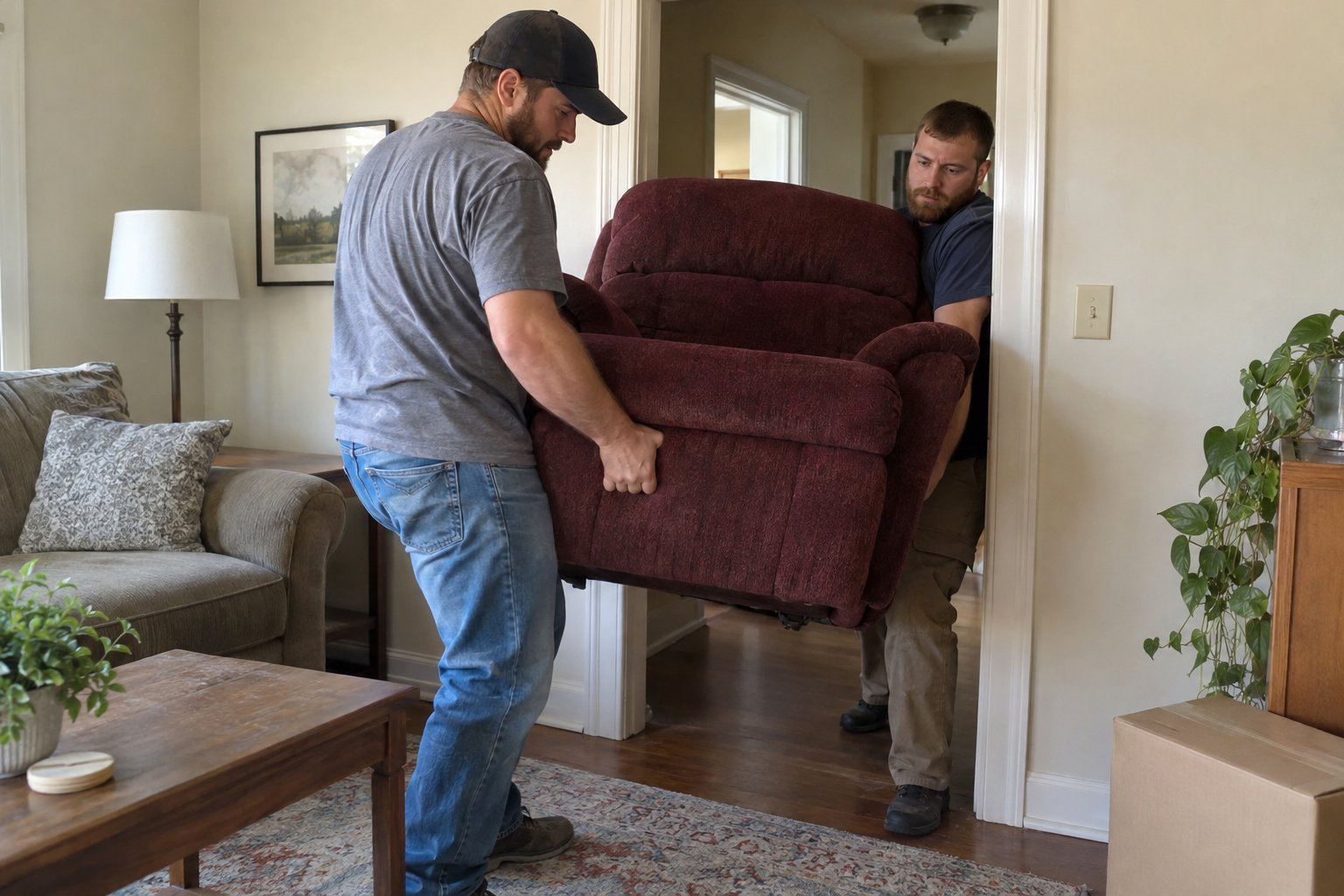
The clearest stress reduction usually shows up around the physical risk of the move: the fear of hurting your back, dropping something heavy on stairs, or damaging a doorway carrying a couch through it. Those are the exact moments where an extra set of trained hands changes the day from exhausting to simply busy. If you are weighing whether to do it yourself or bring in help, our DIY moving versus hiring movers comparison walks through where that line usually falls.
You will not eliminate moving stress entirely, and trying to is its own source of frustration. A more realistic goal is to keep stress from compounding: finish decisions early, write down anything you are tempted to just remember, and get help with the parts of the job that are physical rather than personal. Moving will still be tiring. It does not have to be chaotic.
If you want to take the physical load off your plate for your upcoming move, get a moving quote from our team and talk through what parts of the day you'd rather hand off.
Anticipatory anxiety is common before a move because your brain is tracking a long list of unresolved tasks and an unmovable deadline at the same time. The anxiety usually isn't about anything that has happened, it's about the volume of things that still could. Writing out a concrete timeline tends to reduce this because it replaces vague worry with a specific, checkable list.
Because most of the fatigue is mental, not physical. Decision fatigue from sorting belongings, plus the disruption of your normal routines, adds a cognitive load that compounds with the physical effort of packing and lifting. That combination is why people often feel wiped out even on days they didn't do much heavy lifting.
Yes, this is a well-documented pattern. Moving puts everyone in the household under time pressure and decision fatigue simultaneously, which lowers patience across the board. Splitting responsibilities clearly ahead of time, so each person owns specific tasks rather than overlapping on everything, usually reduces the friction.
Most people find that starting six to eight weeks out, with decluttering first and packing second, keeps the final two weeks from becoming overwhelming. The goal isn't to finish early, it's to avoid making every decision in the same short window.
Yes. You don't need to hand off the entire move to get meaningful relief. Many people find that getting help specifically with the heavy lifting and loading, while handling their own packing and admin tasks, removes the part of the move they were dreading most without giving up control of the rest.
Whether it’s a full home move or just a few heavy items, Hustle and Muscle Moving is ready to help you sort it out.