.webp)
Written by:
Pierce J.
Published:
August 7, 2026
Learn how to move a treadmill or elliptical without injury or damage. Folding, disassembly, dolly technique, and truck loading tips from a moving crew.
If you are trying to figure out how to move a treadmill without throwing out your back or scratching up your hallway, the short version is this: fold it flat if it folds, take off anything that sticks out, and get it onto a dolly before you ever try to lift it. Treadmills and ellipticals are deceptively heavy for their footprint, usually somewhere between 200 and 400 pounds depending on the model, and most of that weight sits low and off-center. That combination is exactly what causes back injuries and gouged doorframes when people try to walk one out like a couch.
This guide covers what to do before moving day, how to break the machine down safely, the actual technique for getting it out the door and onto a truck, and what changes if you are moving an elliptical instead of a treadmill. None of this replaces the owner's manual for your specific machine, but it will get you through the parts every model shares.
Preparation means folding the deck if your treadmill supports it, unplugging and coiling the power cord, and removing any loose parts like the safety key, water bottle holder, or tablet mount. Skipping this step is the number one reason moving day takes twice as long as expected.
Start by consulting the manual or the manufacturer's website if you no longer have it, since fold-and-lock mechanisms vary and forcing one incorrectly can snap the hydraulic assist. Once folded, most residential treadmills lock into an upright position, which cuts their footprint roughly in half and makes them much easier to walk through a doorway. If your machine does not fold, you are working with the full deck length, so measure your doorways and stairwells now rather than discovering a problem halfway through the hallway.
Ellipticals generally do not fold, and their pedal arms and handlebars stick out in ways that catch on doorframes and railings. Before moving day, remove the handlebars if your model allows it with a hex key, and tape or bag any loose bolts you take out so they do not get lost or become a tripping hazard.
Full disassembly is usually unnecessary for a local move but worth doing for a long-distance one. For a move across town, folding the deck and removing the console is typically enough. For anything going on a truck for hours or across state lines, pulling the console off entirely and securing the belt reduces the risk of cracked screens and stretched belts.
To remove a console, most models require unscrewing a few bolts at the base of the upright posts and disconnecting a wire harness, which you should photograph before unplugging so reassembly is not a guessing game. Wrap the console in a moving blanket or bubble wrap and transport it separately from the frame, ideally in a box in the cab rather than bouncing around in the truck bed.
The safest way is to get the machine onto a hand truck or appliance dolly and tilt it back onto the wheels before anyone lifts a corner. Trying to carry a treadmill by hand, even with two or three people, puts uneven strain on whoever is at the heavier end and is how most moving-day back injuries happen.
Slide furniture sliders or a moving blanket under the base first so you can pivot the machine toward the dolly without dragging it across hardwood or carpet. Once it is strapped to the dolly, one person tilts and steers while a second person walks ahead to open doors, spot stairs, and call out obstacles. On stairs, always keep the heavier end on the downhill side under control rather than letting gravity pull it, and take breaks on landings rather than trying to power through in one push.
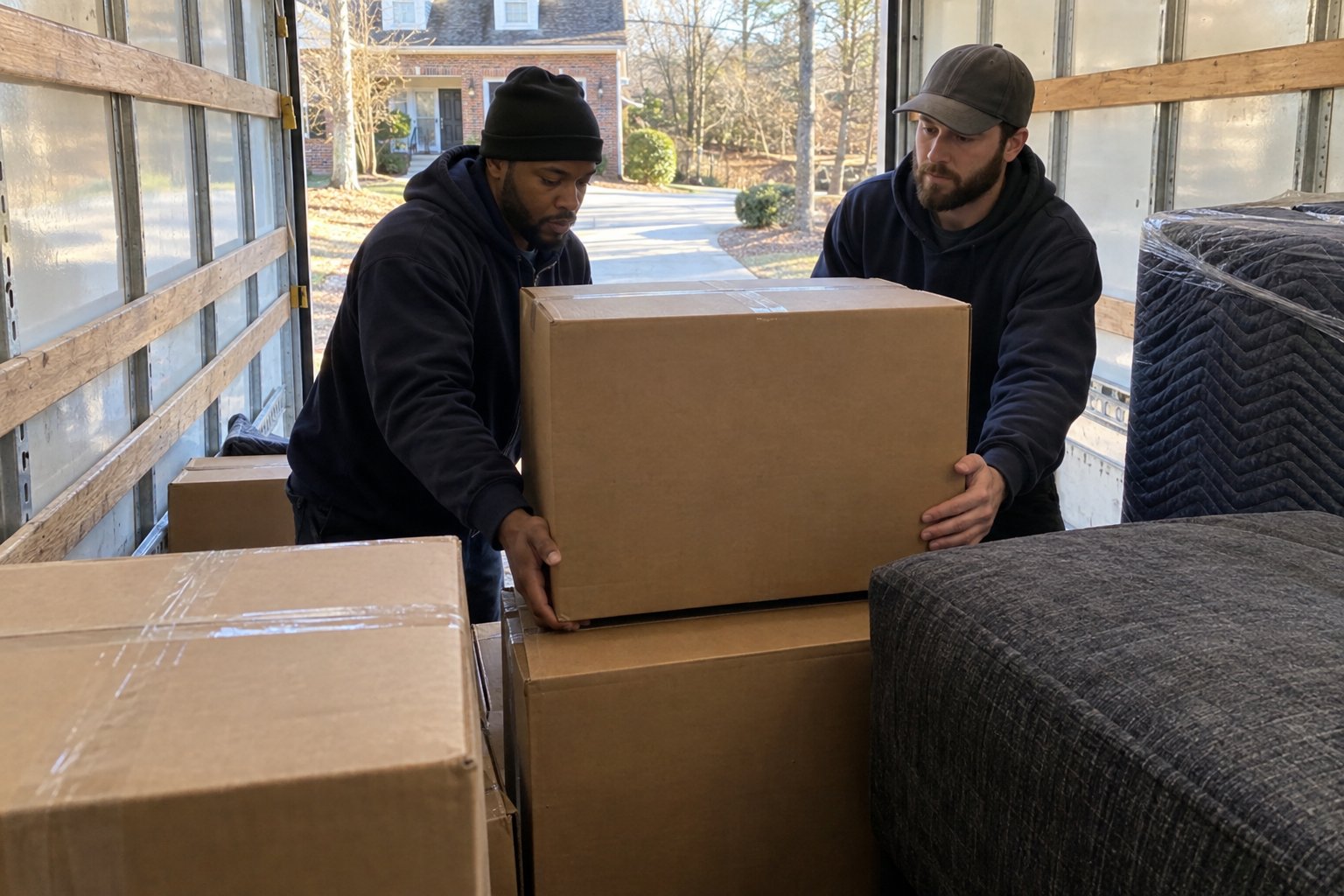
Exercise equipment should go against a wall of the truck, standing on its narrowest footprint if it is folded, and strapped tightly so it cannot shift or tip during transit. Loose equipment is one of the more common causes of damage to everything stacked near it, since a few hundred pounds sliding a few inches on a hard brake can crush boxes or dent other furniture.
Place moving blankets between the machine and the truck wall to prevent scuffing, and use at least two straps at different heights so the load cannot pivot forward or sideways. If you removed the console, box it separately and load it somewhere it will not get crushed, ideally on top of soft items rather than under anything heavy.
Two able-bodied people with a dolly and a plan can usually manage a single treadmill on a local move, but a home gym with multiple machines, a treadmill on an upper floor, or a long flight of stairs is where it makes sense to bring in help. The cost of a strained back or a cracked stair tread almost always exceeds the cost of an extra set of hands for an hour.
If you are relocating an entire home gym setup rather than one machine, it is worth looking at labor-only assistance to get trained help loading and carrying without paying for a full-service move you do not need. For moves that also involve packing the rest of the house, a broader local and long distance moving crew can fold equipment moving into the rest of the job so it is not a separate headache on top of everything else.
Moving a treadmill or elliptical comes down to preparation, the right equipment, and not underestimating the weight. Fold and secure loose parts first, get the machine onto a dolly before anyone lifts, and strap it down properly once it is in the truck. If you are already coordinating a larger move and would rather not handle a 300-pound machine yourself, get a moving quote and have it handled alongside everything else.
No, you can unplug it the same day, but you should coil and secure the cord so it does not drag or become a tripping hazard while the machine is being moved. There is no benefit to disconnecting power any earlier than moving day itself.
Some manufacturers advise against laying a treadmill flat because it can strain the motor mount or cause fluids in the motor housing to shift into places they should not be. Check your specific manual, but when in doubt, transport it upright and folded rather than on its side.
Most residential treadmills need at least two people once the machine is on a dolly, one to tilt and steer and one to spot doorways, corners, and stairs. A single person attempting it alone is one of the more common ways treadmills end up damaged or people end up hurt.
Most home treadmills do not require recalibration after a move, but it is worth checking that the belt is centered and running smoothly once it is set up, since a shift during transit can occasionally throw off alignment slightly.
It is better to remove the safety key before the move and pack it separately in a labeled bag with other small hardware. Leaving it inserted risks it snapping off or getting lost during handling, and you will need it to power the machine back on later.
Whether it’s a full home move or just a few heavy items, Hustle and Muscle Moving is ready to help you sort it out.