Written by:
Pierce J.
Published:
October 23, 2026
Learn how to move heavy furniture up or down stairs without injury or damage, from body mechanics to the right equipment and when to call in help.
Stairs turn an ordinary piece of furniture into a serious hazard. Learning how to move heavy furniture on stairs safely comes down to controlling the weight with your legs and a partner instead of your back, and keeping the load stable through every turn on the landing. Most stair injuries and most gouged stairwells happen for the same reason: someone tried to muscle a sofa or dresser around a corner without a plan.
This guide walks through the body mechanics, the equipment that actually helps on stairs, and the specific pieces that cause the most trouble, so you can get furniture up or down without a trip to urgent care or a scraped-up stairwell.
Stairs are dangerous because they remove your footing, your sightline, and your ability to adjust grip all at the same time. On flat ground you can reposition your feet or pause mid-carry. On a staircase, every step changes the angle of the load and the angle of your spine, and there is nowhere to set something down if your grip slips.
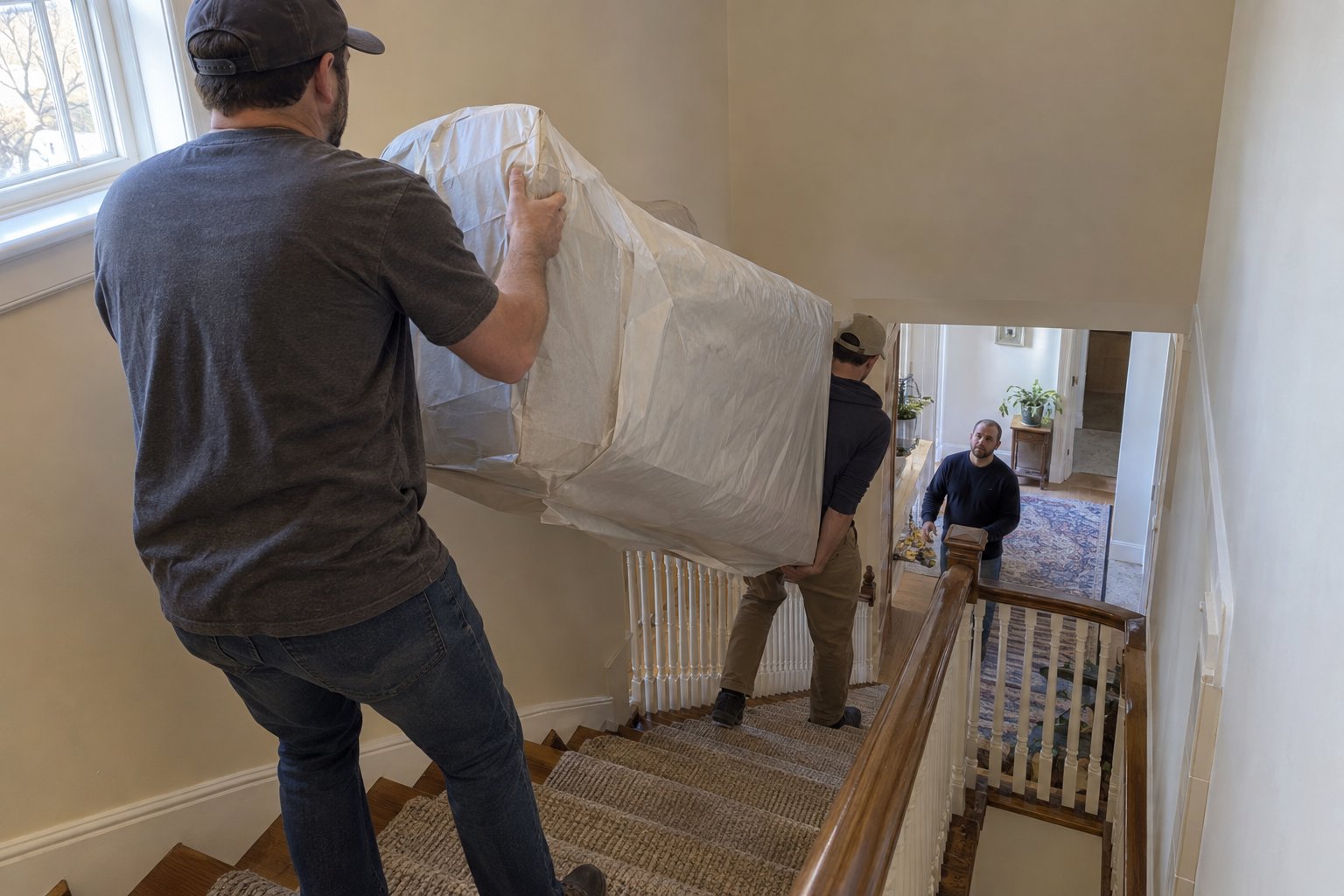
The person on the bottom of an incline carries more of the weight than the person on top, often without realizing it. On a descending staircase, the lower carrier can end up supporting 60 to 70 percent of the load simply because gravity pulls the furniture toward them. That imbalance is why the bottom position should always go to the stronger or more experienced mover, and why constant verbal communication between carriers matters more on stairs than anywhere else in the house.
Going down, the lead carrier should be below the furniture, moving backward one step at a time while the top carrier controls the tilt. Keep the heavier end slightly higher than the lower end whenever possible, since a load that tips forward on a descent is far harder to arrest than one tipping backward.
Take the stairs one tread at a time rather than trying to glide down a flight. Call out each step ("down," "down," "landing") so both carriers move in sync. If the staircase has a turn or a half-landing, stop there, reset your footing and grip, and reassess the angle before continuing. Rushing a turn is when corners get gouged and backs get strained.
A lot of moving advice focuses on keeping your arms straight, but what actually protects your back is keeping your spine in a neutral, upright position and letting your hips and knees do the bending. On stairs, this means facing the direction of travel when you can, rather than twisting at the waist to look over your shoulder.
Going up, the stronger carrier should be on the bottom, pushing and lifting from the legs while the top carrier guides and steadies rather than pulls. Pulling a heavy piece up by its top edge puts enormous strain on the lower back and wrists, and it is a common way to tear a muscle on moving day.
Use short, controlled lifts from step to step instead of trying to power up several stairs in one motion. If the piece has legs or a narrow base, consider removing legs first so the item sits lower and tilts less aggressively on each step. For anything over roughly 150 pounds, a two-person carry is the minimum; some pieces genuinely need three or four hands.
A stair-rated appliance dolly with a ratchet strap is the single most useful tool for narrow, straight staircases, since it lets one piece of furniture ride on wheels with a stair-climbing tread instead of being carried entirely by hand. Furniture sliders help on flat landings between flights but offer little benefit on the actual steps themselves.
Moving straps, worn over the shoulders, redistribute weight from your arms and lower back to your legs and core, which matters even more on an incline than on level ground. A few other things worth having on hand:
None of this equipment replaces having a second set of hands. Straps and dollies make a hard carry more manageable; they do not make a two-person job safe for one person.
Tall, top-heavy pieces like bookcases and wardrobes are the hardest because their center of gravity shifts dramatically with every degree of tilt on a staircase. A dresser or sofa is awkward but relatively predictable; a six-foot bookcase can tip past the point of control before either carrier feels it happening.
Spiral staircases and staircases with tight 90-degree turns are their own category of problem, since there is often no straight path long enough to fit a long sofa or mattress at any angle. In those cases, it is worth measuring the staircase width, the turn radius, and the ceiling height before moving day, not during it, so you know in advance whether a piece needs to go up over a balcony or through a window instead.
If you are managing a narrow turn with a long couch, our guide on moving a couch through tight stairwells covers the specific pivoting techniques for that scenario in more depth.
Call in help when a piece is too heavy for the people available, when the staircase geometry does not leave room for error, or when the item itself (a piano, a safe, an oversized sectional) is simply not built to be hand-carried around a landing. There is no shame in recognizing that a staircase has turned a two-person job into a four-person job.
A trained crew brings not just extra hands but the straps, dollies, and experience to read a staircase before committing to a lift. If you are weighing whether to tackle a stairwell move yourself, our labor-only assistance service lets you bring in muscle and equipment for just the heavy-carry parts of the job without booking a full move. For the rest of the house, planning ahead with a loading strategy for the truck keeps the staircase carry from being undone by a bad load later.
If you would rather hand the whole staircase problem to a crew that does this daily, get a moving quote and let them handle the heavy lifting from the top step to the truck.
Neither direction is inherently easier; what matters is which carrier takes the bottom position. Going down, the bottom carrier should be the stronger mover since they absorb most of the weight. Going up, the bottom carrier does the lifting and pushing while the top carrier steadies the load.
A stair-climbing dolly reduces the physical strain, but a single person still cannot control tilt, balance, and footing on a staircase alone for anything beyond light items. Most stair-rated dollies are designed to be used with at least one person guiding from below or above.
Stand the couch on end, tilt it to the angle that clears the narrowest point of the turn, and move in small increments while one person checks clearance on each side. If the turn radius is too tight at any angle, the couch may need to go up and over a balcony or through a window instead.
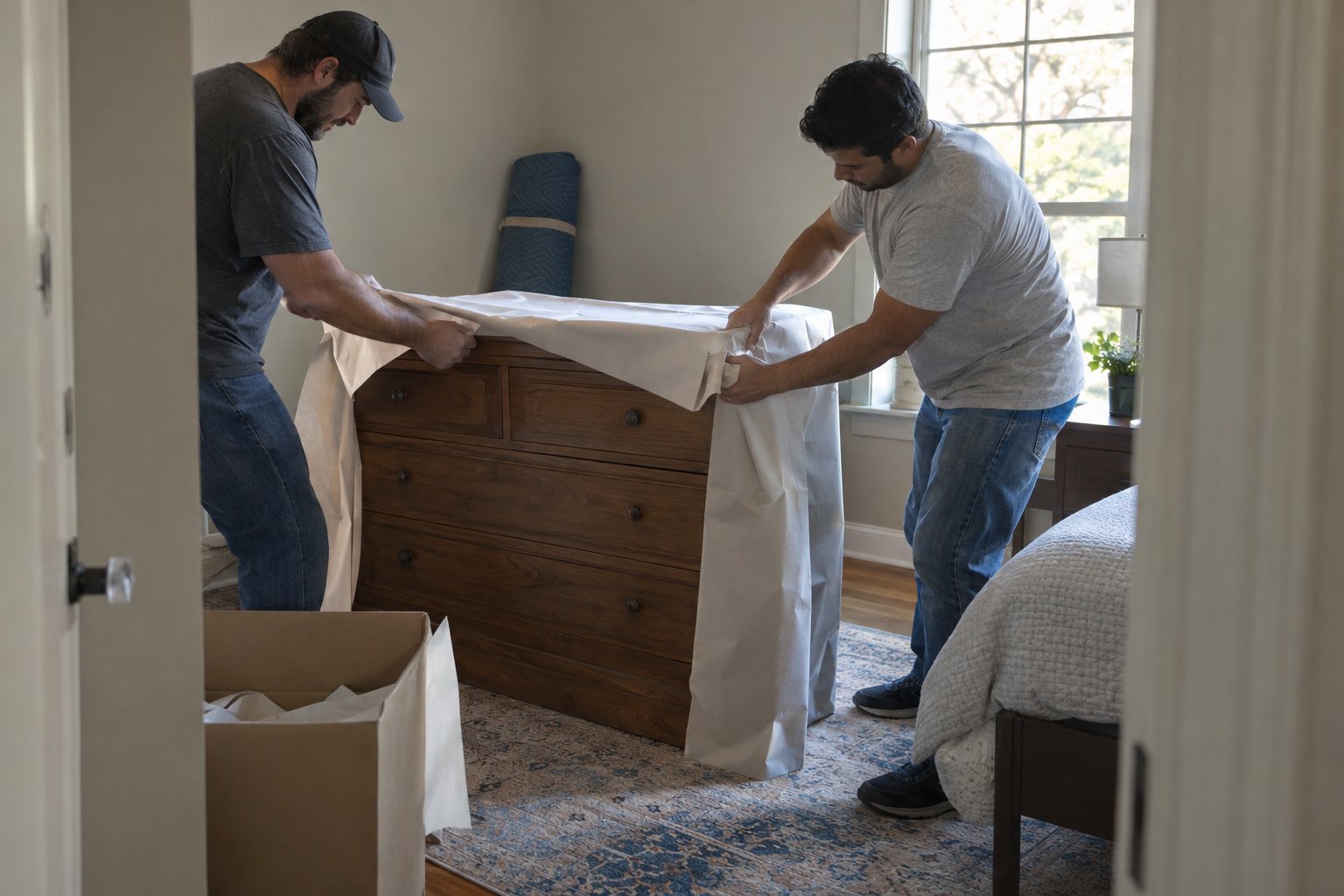
Position the dresser close to the base of the stairs, bend at the knees and hips rather than the waist, and lift together on a verbal count so both carriers raise the piece at the same moment. Avoid twisting your torso while lifting; pivot with your feet instead.
Furniture sliders work well on flat landings and level floors but are not designed for use on the actual steps of a staircase, where they can cause a piece to slide unpredictably. Save sliders for maneuvering furniture into position once you reach a flat surface.
Whether it’s a full home move or just a few heavy items, Hustle and Muscle Moving is ready to help you sort it out.