.webp)
Written by:
Pierce J
Published:
July 1, 2026
Learn how to move a TV without cracking the screen. Our step-by-step guide covers packing, loading, and transporting flat screens of every size safely.
If you're trying to figure out how to move a TV, you're dealing with one of the most fragile and awkward items in any home. Modern flat-screen televisions — whether LED, OLED, or QLED — look sturdy in your living room, but they are remarkably vulnerable to damage during a move. The screens are thin, the panels flex under their own weight when unsupported, and a single bump against a doorframe or a shift inside an unsecured truck can crack the display beyond repair. A cracked TV panel is almost always more expensive to replace than the set is worth.
The good news is that TV moves go smoothly when you take the right steps in the right order. This guide covers everything: how to prepare your TV before it moves, what packing materials you actually need, how to carry and load it safely, how to secure it in the truck, and how to set it up correctly at your destination. Whether you're moving a 40-inch bedroom set or an 85-inch living room anchor, these principles apply.
The biggest mistake people make when moving a TV is treating it like a last-minute item — something to grab off the wall the morning of the move. Proper preparation takes more than five minutes, and skipping it is the most direct route to a cracked screen.
Before you unplug anything, take a clear photo of the back of the TV with all cables still connected. This takes ten seconds and will save you significant frustration when you're reassembling your entertainment setup at the new home. Label each cable with a piece of painter's tape and a marker — HDMI 1, power, soundbar, cable box — so reconnection is straightforward. Coil each cable loosely, secure it with a twist tie or rubber band, and bag them together in a labeled zip-lock bag.
If your TV sits on a pedestal stand, remove it before the move. Most stands detach with two to four screws on the underside of the base; keep those screws in a labeled bag taped to the stand itself. If the TV is wall-mounted, you'll need to remove it from the bracket — typically by releasing a locking tab and lifting the set off the mount. Wall mount hardware varies by brand, so consult your mount's manual if you're unsure of the release mechanism. Do not attempt to transport a TV with the wall bracket still attached; the protruding arms create stress points and make safe padding nearly impossible.
The single best container for moving a flat-screen TV is its original factory box, complete with the molded foam inserts designed specifically for that model. If you kept it, this is your best-case scenario — unpack the foam, seat the TV carefully, and close the box. If you no longer have the original packaging (which is most people), your next best option is a purpose-made TV moving box. These are available at moving supply stores and many home improvement retailers in a range of sizes. They're double-walled, specifically dimensioned for flat panels, and significantly safer than improvising with whatever cardboard you have on hand.
Whether you're using the original box, a TV moving box, or building a makeshift solution, the packing process follows the same priorities: protect the screen, immobilize the TV inside the container, and cushion against impact from every direction.
Start by placing a clean, soft blanket or piece of foam sheeting directly against the screen. Do not use newspaper or paper packing material directly on the screen — the texture can scratch the anti-glare coating. Avoid bubble wrap directly on the screen as well; the bubbles can leave impressions on some panel types if pressure is applied. A moving blanket or a clean microfiber cloth laid flat across the display provides a safe first layer. Secure it gently with stretch wrap or tape — tape the wrap to itself, never directly to the TV's frame or screen.
Slide the wrapped TV into the box with the screen facing the widest panel wall — never face-down. Fill any gaps along the sides and top with additional packing material: foam sheets, bubble wrap (not touching the screen directly), or balled packing paper. The goal is zero movement inside the box. If the TV can shift when you gently shake the box, add more material. Write "FRAGILE — THIS SIDE UP — DO NOT LAY FLAT" on multiple sides of the box in large, visible letters.
In situations where a proper TV box isn't available, wrap the TV completely in moving blankets — at least two full layers — and secure the blankets tightly with stretch wrap. This isn't ideal, but it's significantly safer than moving an unwrapped flat screen. The most important rule in this scenario: the screen must always face upright and away from any hard surface. Leaning a blanket-wrapped TV face-in against a hard wall or truck panel is a common and costly mistake.
A properly packed TV still requires careful handling during the carry and load. The screen is the weak point, and lateral pressure — particularly anything that flexes the panel — is the main risk during this phase.
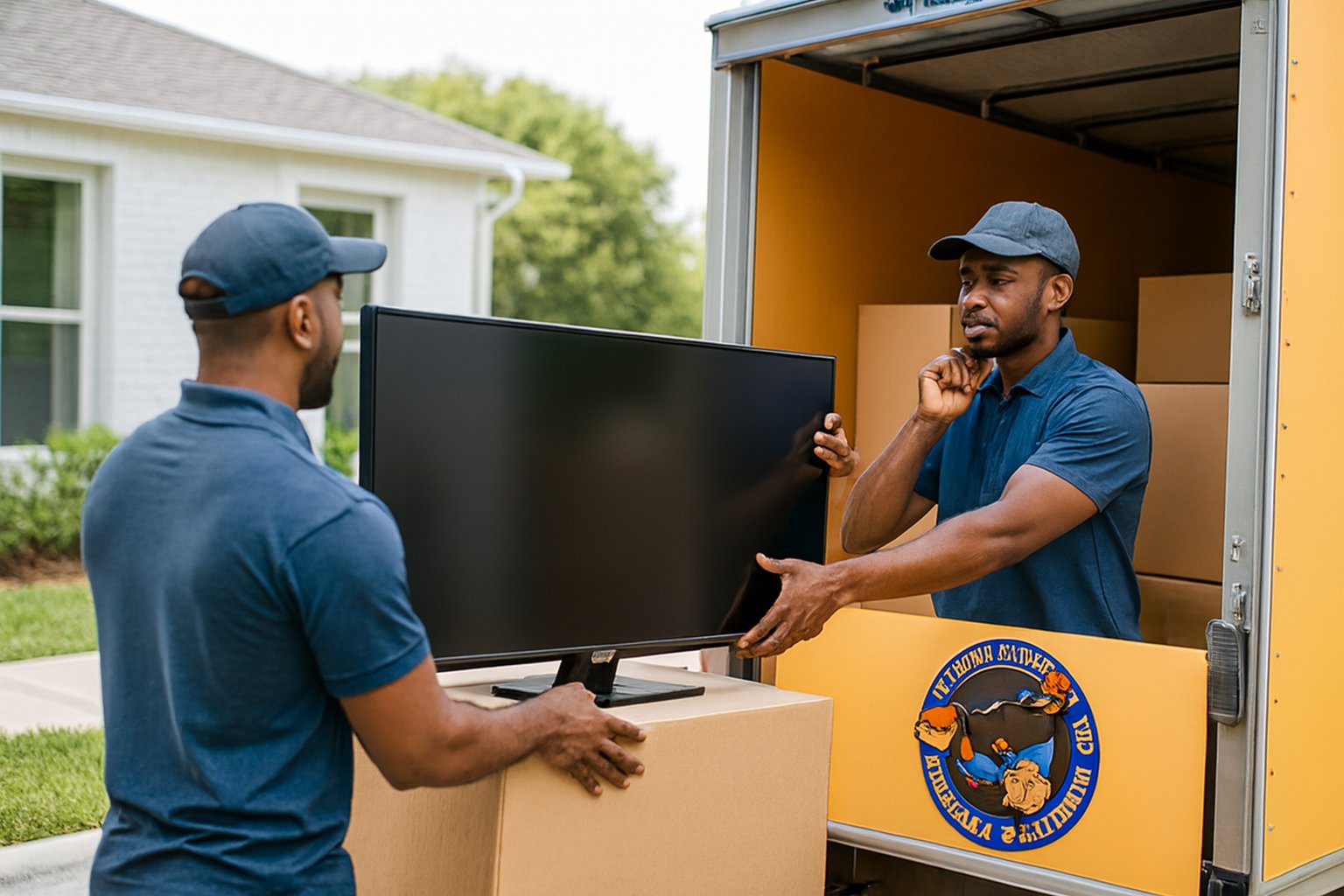
Flat-screen TVs must be transported and carried upright, with the screen vertical, not horizontal. Carrying or laying a flat screen horizontally — even briefly — puts stress on the unsupported center of the panel. Large screens in particular have enough weight that horizontal transport without internal support can cause the panel to flex and crack under its own mass. Two people should carry any TV larger than 50 inches: one on each side, hands on the outer frame only, never on the screen.
In the moving truck, the TV should stand upright — screen facing inward toward the truck wall, not toward loose items in the cargo area. The best position is wedged vertically between two pieces of padded furniture, such as a mattress and a sofa, that can act as natural stabilizers. Use moving straps or rope to secure the TV against the wall so it cannot tip or shift in transit. Never stack items on top of a TV, even a boxed one. For a comprehensive look at how to arrange everything in the truck, see our guide on how to pack a moving truck like a pro.
Navigating a large boxed TV through doorways and down stairs requires a second set of hands. Measure your TV box against any tight doorframes or stairwells before you try to push through — a box that doesn't fit upright may need to be carefully angled (not laid flat) through the opening, then returned to upright immediately. On stairs, one person leads at the bottom and one guides from the top, with the TV kept as close to vertical as possible throughout.
Once the truck is unloaded, resist the urge to rush the TV setup. A few careful steps here protect everything you did during the move.
Unbox the TV in a clear, open area — not a cluttered hallway. Remove all packing material carefully and inspect the screen and frame for any signs of damage before mounting or connecting anything. If there is damage, document it with photos immediately. Check the screen from multiple angles in good light — panel cracks sometimes appear as dark patches or lines that aren't obvious at first glance.
If the TV was stored in a cold truck during winter weather and is being moved into a warm home, give it 20 to 30 minutes to reach room temperature before powering it on. Condensation inside electronics can cause problems, and a brief acclimation period reduces that risk.
Reattach the pedestal stand using the screws you bagged during disassembly. If the TV is going back on a wall mount, verify that the wall anchors at the new location are properly rated for the TV's weight before hanging — not all walls and studs are the same. Use your cable photo from earlier to reconnect everything in the correct order, and power the TV on before considering the job complete.
For most household moves, a properly packed flat-screen can be handled by two careful people. But there are situations where professional help makes sense. Very large screens — 75 inches and above — are physically demanding to carry safely and expensive to replace if something goes wrong. If your move involves multiple flights of stairs, extremely narrow hallways, or a long-distance truck route with lots of road vibration, the risk profile increases. A labor-only moving service can handle the heavy lifting and awkward carry while you focus on everything else. For specialty items like projection systems, commercial displays, or oversized screens, our specialty moving service is worth a conversation before you attempt it alone.
The cost of a professional carry is almost always less than the cost of a new flat-screen television — and significantly less than the frustration of arriving at a new home with a cracked screen and no clear path to a replacement.
No — flat-screen TVs should always be transported upright, with the screen in a vertical position. Laying a flat screen horizontally removes the structural support the frame provides and allows the panel to flex under its own weight, which can crack the screen internally even without an obvious impact. This is especially true for larger screens, where the panel's own mass is enough to cause damage during a bumpy ride. Keep the TV vertical from the moment it leaves the wall to the moment it arrives at its destination.
The best alternative to the original box is a purpose-made TV moving box, available at most moving supply stores and home improvement retailers in standard size ranges. These are double-walled and designed specifically for flat panels. If a TV box isn't available, wrap the TV in at least two full layers of moving blankets, secure the blankets with stretch wrap, and transport the set upright. Never use newspaper directly on the screen — it can scratch the anti-glare coating. Fill any gaps in the box with foam or bubble wrap (not directly touching the screen) to prevent movement during transit.
Start with a clean, soft layer directly on the screen — a moving blanket or microfiber cloth works well. Do not apply tape directly to the screen or the TV's frame. Secure the protective wrap with stretch wrap taped to itself. Place the TV in a box with its screen facing a padded wall and fill all gaps with packing material so there is zero internal movement. In the truck, position the TV upright between padded furniture items and secure it with straps so it cannot tip or shift. Write 'FRAGILE — THIS SIDE UP' clearly on the box.
For TVs 50 inches and under, one careful person can manage on flat ground, though two is always safer. For TVs larger than 50 inches, two people are the minimum — one on each side, hands on the outer frame only. On stairs, three people are strongly recommended: one leading at the bottom, one guiding from the top, and one spotting from behind. Very large screens — 75 inches and above — are heavy enough and awkward enough that professional movers are worth considering, both for safety and to protect the investment.
Yes — it's best to remove the TV from its wall mount before the movers arrive if possible. This allows the crew to focus on carrying the set safely rather than spending time on the dismount, and it gives you control over how the TV is handled during the most delicate part of the process. Remove the stand or bracket, bag all hardware with clear labels, and have the TV ready to be wrapped and packed. If the wall mount is going to the new home, remove the bracket from the wall separately and transport it without the TV attached.
Whether it’s a full home move or just a few heavy items, Hustle and Muscle Moving is ready to help you sort it out.